Monday, August 28, 2017

UUUUUH-LAAAA! Jeff Wayne’s War of the Worlds: The Amazing Prog-Rock Acid-Trip That No One’s Ever Heard Of


Still busy on the novel editing this month, so instead of short or flash fiction, it’s more reviews! Because who doesn’t love the 70’s?


In the last years of the twentieth century, a time we look back on with fondness and nostalgia and just a slight confusion over how it went horribly wrong (is that just me?) there was a man called Jeff Wayne. Wayne and his buddies were a bunch of dreamers and thinkers in pre-Thatcher England who were riding the purple-haze wave of 70’s rock. And somehow, somewhere, one of them asked:
 
“Wouldn’t it be cool if we did a psychedelic concept album, based on H.G. Wells?”

In any other decade, the answer would have been “give me the bong, you’ve had enough, Jeff.” (The idea was actually suggested by Jeff’s dad, but I imagine the response would’ve been the same.) And in any other decade a silly, fun idea like this would have met with crushing failure. But this was 1978, and the world was inundated with tie-die extravagance, bell bottoms and the wishful artistic idealism of the sixties, which hadn’t completely congealed. So, like a bunch of absolute madmen, Jeff and his buddies went and actually made the album.

Let me give you a taste of its pure, flawless camp.


 How crazy is this? It’s literally just a guy (the excellent Richard Burton, who offered his services after a personal letter from Wayne) grimly reciting lines from the original “alien invasion” book itself. Just when you think maybe you accidentally popped in a book-on-tape rather than a masterpiece of alt-pop, WHAM, they whack you over the head with orchestral silliness! And then there’s the absurdly fun sound effect that goes “P’TCHOOoooo!” as the Martians fire their canisters towards Earth. It's beautiful.

Also hilarious. Are you laughing yet? Good. Laugh now, Earthlings… Laugh while you still can. Because the worst is yet to come. Oh, yes, Earth will have its reckoning. Soon...

In a concept-album tradition, the story jumps directly to the next phase of the story: the Martian arrival, on idyllic Horsell Common. The first track wraps with an Elysian vision of rumbling trains, quiet evening bustle, and general British well-to-do-ness. One of my favorite things about this album is how perfectly it skewers the comfortable homeland atmosphere of Britain: shows like Downton Abbey would have us believe old-timey Victorian Britain was a garden paradise, filled with mincing earls and fancy hats. The reality, of course, was a massively xenophobic empire that ruled the seas with an iron grip for over a century. The insidious attack of the Martians is a sort of “karmic rebound” that Wayne plays with masterfully. Let’s get our first glimpse of these squamous invaders:


Damn! Things are getting real. From the Darth Vader-esque sound effects to the startling, unnerving bleeps and bloops of the synthesizer, we immediately get the sense that Something Wicked has arrived. The Martians don’t speak, or try to communicate: they follow the grim pattern of Wells’ original vision, mercilessly exterminating a band of peacemakers who try to welcome them. These guys don’t come in peace. It’s funny to note how this idea of the merciless invader played with Britain’s fears at the time: for a nation so secure, so comfortably on top of the world, they were awfully paranoid about getting invaded. Wells’ book was immensely popular and to this day carries weird, xenophobic undercurrents: the Bad Other Species is coming! They’re going to ruin your way of life! Watch out! “Hide your kids, hide yo’ wives!” If this sounds a bit Trumpy to you, it’s because it is—Wells was focused on the possibility that the new discoveries of the 20th century would be grim and horrifying, but his book’s popularity is due to that cow-like fear of the Outsider. The same unreasoning fear which spawned Brexit, and caused the same countries that survived WW2 to reject immigrants fleeing murderous regimes. There are layers to this, and we won’t get into them here… because the Tripods have arrived, and nothing can save you now anyway. 


AHHH! Holy fucking shit, dudes!

The musical cues are so on-point here you can practically see the gleaming metal monsters stomping over Britain’s countryside, demolishing buildings, melting people to ash with their heat-rays and generally acting Big, Scary and Alien. This is the money shot, the moment that establishes how England gets outstripped by alien technology. The military makes a stand against the Martians, and naturally gets their shit slapped. “Bows and arrows against the lightning,” as our Artillery-Man says. It’s a madhouse out there! Run for your lives!!!

Through it all, excellent synthesizer music warbles and trills, swoops and undulates. I’m not much of a music snob, but I know synth music hasn’t been popular since Wayne’s heyday—the only exception being ‘arthouse’ movie soundtracks like Drive or ‘retro’ appeal in Stranger Things. But here, it’s hard to imagine any sound that would so effectively capture both the cheesy tone of the album itself, and the giddy mad terror of a real extraterrestrial attack. This sheer attention to detail calls to mind the famous radio play, where Orson Welles (no relation) successfully convinced most of urban America that the Martians were here to kill them. You can laugh, and shrug off the bleeping and blooping and the zany laser-blasts, but at its heart this scene is serious: people are dying, roasted to death or crushed by the Martians, who stride over it all in their god-like machines with all the callous disinterest of a farmer spraying crops. It’s chilling.


I’m tempted to compare it to drone warfare—the Young Artilleryman, who teams up with Burton’s narrator, has a bad dose of PTSD going on. But there are plenty of analyses of Wells’ work in the context of modern warfare. You can Google ‘em. Instead of soapboxing, I have just one thing to say:


Straight from the track, this is our first exposure to the deeply unsettling, yet comically over-the-top Martian war cry, a noise that makes your eyes bug out and makes you ask “Are these guys serious?” Yes. Yes, they are. And the line gets callbacks throughout the album, so get used to it. Wayne’s interpretation of “UUUH-LAAA” is not up for scholarly debate, but it seems like the Martian equivalent of an Inception-blare, to frighten humans and scatter them for slaughter. It’s much more silly in the book, as the tepid “Ulla-Ulla!” war cry. Wayne and Spielberg rightly thought it could be much creepier, if done properly.

But enough of that—the war for Earth has begun. Let’s move our needle over to the next dose of eargasm.


Yeah, uh… What?

There’s a shift in tone here. “Forever Autumn” derails the earlier action, but it also showcases the variety of music Wayne and his pals have mastered. We go from blaring, stomping, murdering Fighting-Machines to the depiction of mankind fleeing the Martians, accompanied by voiceovers and painfully 70’s vocals and strings. It’s like “Simon and Garfunkel Does the Apocalypse.”

To sum up: The Narrator is riding to the rescue of his bride, the distant and unfortunately song-less Carrie. Carrie is one of several characters who don’t exist in the original novel, and in the album she seems to be added just to give the Narrator motivation to run around like a moron looking for her. Thankfully the songwriters didn’t “fridge” her for the sake of drama, but she only gets one scene and that’s it—poof. She’s out of the story. Kind of a bummer when she’s the Narrator’s ENTIRE motivation for going to London, but whatever.

Anyway, I feel like this track is underrated. Rumor has it that the refrain is actually a Lego advertisement jingle, which Wayne put into the album because Lego rejected it. If that’s true, it does explain the tonal shift, and the “purple” lyrics. “Like the sun through the trees, you came to love me”? Really? How exactly does the sun come through trees to ‘love’ anyone? I’m pretty sure it comes through the trees to cook us with cosmic UV rays, but sure, fine. Every track can’t be a winner—and I challenge you not to start humming “Forever Autumn” weeks after listening to it. It’s an ear-worm, just as insidious as a Martian tentacle.

Moving on, we come to the gangbuster track, the one that will make you pump your fist despite the absolute balls-to-the-wall silliness. Welcome, my shell-shocked friends, to “Thunderchild.”


Below is an accurate depiction of my face, the first time I heard this song:


"FUCK MARS!!"
Excuse me while I set this as my desktop wallpaper, phone screen and screensaver, and lip-sync "FAREWELL, THUNDER-CHIIIILD!" on repeat.

Unfortunately, "Thunder-Child" is the last really intense track the album has to offer. After this point, we are treated to the creepy but very slow-paced onslaught of the Martian terraforming plant, a real thing from the novel. It’s very trippy and surreal, but not exactly a masterpiece—and it gets a “part 2,” likely because Wayne ran out of material while making the album. Truth be told, there is not a lot of narrative substance to “War of the Worlds.” It’s a very straightforward story, told in crisp journalistic fashion. The aliens come, they conquer, they are defeated. Which is where we get tracks like this:


Woof. That’s a rough listen, my friends. Not just for the repetitive lyrics, the over-acting from our Parson (the excellent Phil Lynott, given nothing much to do here, 'cept bitch about Satan) and the lack of ANYTHING ACTUALLY HAPPENING in this track’s narrative. Let me break down the song's theological debate for you:

  • The Parson, a character established in the album, is wounded by Martians but alive. His wife comes to say hi. The Parson tells her to bugger off, because she’s a Martian possessed by the Devil… or something.
  •  Beth, the parson’s wife, tells him to stop being an idiot—these are Martians, not demons.
  •  The Parson is all like “Bro! These be demons, bro. I’m telling you bro. There’s nothing left to live for, we’re done. Game over, man. Game over!”
  • Beth disagrees. Rinse and repeat until a cylinder falls on the cast, conveniently killing her so the argument can end. (Sorry, Beth!) 

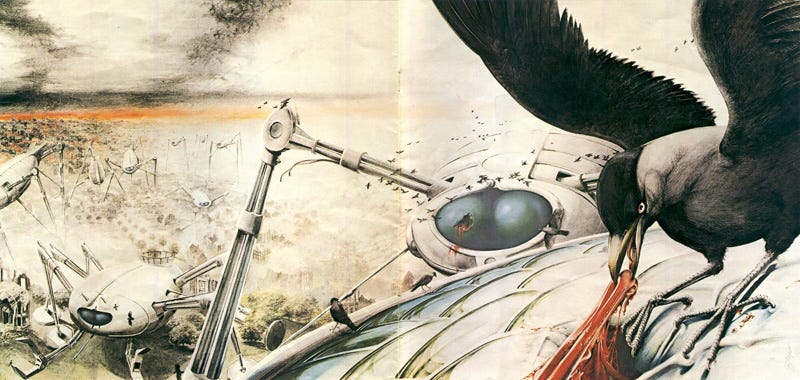
The “argument” they have is bare-bones, too: it’s made of sweeping statements about Mankind™ and the Spirit of Man™ that don’t really fit in the mouths of the characters. We’ve gone from subtle allegories of xenophobia and broken faith, to LITERAL actual xenophobia and broken faith, and it doesn’t really work. But the performances are passionate, and the music is fairly catchy, which is the best you can ask from a clunky sermon on the evils of humanity. Also, the track gives us badass album art like this:


Tell me you don't want that as a huge poster in your house. I dare you.

This brings us to the lackluster conclusion of the album. Before the second disc wraps up, we are treated to the delusions of the Young Artilleryman, which are… well, a lot of fun, actually.


I love the Young Artilleryman. He’s a great character, and unlike Carrie, the Parson and poor squashed Beth, they actually squeeze a character arc out of him, in this number. He’s gone from a shattered victim of the Martian advance, to a confident (if deluded) one-man rebellion force. This guy makes the cast of Rogue One all look like pansies. “I’m gonna dig a global tunnel network, with ONE shovel! FUCK Martians! Woop woop!”

Good stuff. Aaand then we are sort of rushed to the album’s conclusion by “Dead London,” a spooky but mostly flat track where the Narrator gives up on life after he’s successfully escaped the Martians like, a bajillion times. He hurls himself at the feet of a Fighting Machine, and… Nothing. The Martians are dead, killed in the classic Wells conclusion where they forgot to account for a little something called "bacteria."

(Jesus, Jeff! Do we need to talk about something?)

Which, to me, is like… Okay, maybe they mastered space flight without learning microbiology. Somehow. But it’s still a dud of an ending, redeemed only by the eerie “UUUH-LAAA” refrains, which slowly fade into nothing as the song goes. For the first time, you feel pity for the Martians—they’re dying one by one in their fabulous fighting-machines, victims of the same kind of indiscriminate pain they visited on Earthlings. It’s poetic justice, but it's not exactly a rousing conclusion.

After that, we get a silly epilogue where Wayne tells us NASA’s future adventures to Mars will have a nasty end… Spoilers, they totally find Martians. Science, you have Gone Too Far! Stahp, Science! Cease all progress immediately!! Et cetera.


Well, that’s the album. Incredibly goofy, skillfully made but definitely a relic of its time. Full of galumphing statements about mankind, subtle but eventually over-wrought drama, and lots of cheesy sound effects. And…

It was a hit! It’s almost completely unknown in America, because we can’t have nice things, but in England the goofy bug-eyed tripod from the album cover is a cultural staple. Live shows of the album have been going on for decades. There was a recent techno remix with Liam Neeson. Yes, Liam Neeson, the dad from Taken, calmly narrating Martian attacks. You gotta check it out, it’s hilarious—but not nearly as good as the original. 

The fact that Neeson was even on board should tell you how popular this thing is, in Britain. As recently as 2016, the album was converted to a stage play in London, which I absolutely have to find a cast recording of. It looks great—lots of gears, steam and red lights, and it’s probably just as silly as the album. If you can find it streaming somewhere, let me know. Of course, the play's greasy undertone of xenophobia is present, and noted in the article. The message about scary monsters from another world fleeing their dying planet, to take our resources, has sad parallels in British politics. But hey, it’s got a giant stompy tripod, which walks all over the stage blasting people! That sounds pretty cool. Better than the live-shows put on by Wayne himself, which honestly look like something your uncle who never came down from his high in 1978 might put on, with no understanding of how quickly CGI starts to look 'dated.' Compared to the brief, visionary design of the album, the live-show is pretty tame. At least they have a real orchestra.

But altogether, the album is a crazy, irreverent homage to both Victorian literature and the sheer, creative insanity of the seventies. If I had to salvage a single piece of art from that rotten decade, it would be the music. You wanna know why? I’ll tell you why:


 “UUUH-LAHHH!” That’s why. Any questions? I didn’t think so.

Watch the skies, my friends.

Saturday, July 8, 2017

Political Post: Those Damn Hypocritical Hippies


Strap in, kids--it's soapbox time. This week I go deep into why I hate the smiley-face, the "peace" sign and why the Beatles' legacy bugs the shit out of me.

                Stop me if you’ve heard this one. A crazy foreign dictator waggles nukes at the U.S. as he threatens to wipe every country who doesn’t agree with him from the face of the earth. If anyone so much as LOOKS at him wrong, he’ll do it! Swear to God, he’ll do it!

Sound familiar? Yeah. The Kim family’s been a boogeyman for the U.S. literally since I was a child, taking on Saturday-morning supervillain status. Most of us still see them as toothless—compared to the United States. The odds of us, even of Californians, getting nuked by a bunch of nuts with homemade rockets are pretty slim. While a full-scale nuclear attack would be a tricky thing to fend off (can we stop it? We don’t really know! How exciting!) supposedly a hit from Pyongyang would be like throwing pebbles at a giant. At least, that’s what we’re all trained to think. Despite all the shit the DOD gets for its Godzilla-sized budget and wasteful allocation of resources, we are all conditioned to assume the U.S. is best and smarterest at fending off nuclear attacks, because instead of education we put all our federal dollary-doos into stuff like this. Surely our doom lasers, which can’t shoot through fog or dense cloud, will save us from Kim and his endless armies of starving, brainwashed stormtroopers.

                But that’s a bit of a dark topic, ennit? Let’s talk about peace.

                Specifically, let’s talk about how we look at peace in this country. The 60’s has always fascinated me, and not in a nostalgic way, because I wasn’t there. It’s been immortalized in pop culture ever since the decade itself out. It was, supposedly, the first time a counterculture movement made real dents in the superstructure of America.

                But did it, really? When the lofty-minded flower-children of that era ran smack into the 70’s—into the Manson family, Jonestown, designer drugs and Iran—all of that idealism was lost, and we traded a newer, brighter vision of the world for the Home Shopping Network and Ronald Reagan. No one has ever gotten up since and demanded a complete social revolution. (Well, except for Occupy, but the police infiltrators took care of that pretty efficiently.)

                When I was a kid, I went to a Charter school. And not just any Charter school—a Montessori charter school. Those who know Maria Montessori’s history usually conclude she was a cool person: she was ahead of her time, predicting kids didn’t always learn in a linear, A-to-B fashion. Sometimes to get important info into a child’s fuzzy head, you had to think outside the box. You had to get weird with it.


                They certainly got weird with it, in my school. From elementary all the way through middle school, we were drilled in such exotic policies as the Golden Rule (treat others as you would like to be treated, etc.) and sitting in a forum-style circle during daily meetings. To this day I still wonder if any of that stuff remained in the hearts and minds of students, or if they just brushed it off when they walked out the doors and returned to cable TV, boomer-parents and the Iraq War’s deepening miasma. It was hard to absorb peace and tranquility when your country was bombing a bunch of people into dust on the other side of the planet.

                The Charter school I went to was like a secret hideout, a citadel for hippies and boomer free-thinkers trying out different ways of teaching than smooshing us all into desks and shouting at us. I’ll always be grateful they tried this, though I did get quite a dose of culture shock when I went to high-school after and got my ass kicked for trying to “treat others as I’d like to be treated.” Turns out those policies are pretty hard to apply in the quote-unquote Real World, and people have a tendency to call you a pussy and a fag when you practice non-violence.

                Anyway, peace. Peace is tricky and nebulous, especially in a country that hasn’t been out of international conflict since the years after WW2, and that was just before we said “hey Korea, how’s it going, we got bored not shooting stuff so GIRD YOUR LOINS, HERE COMES ‘MERICA.”


                We all want peace in the USA, right? We’d all love to see a world where the news isn’t filled with suicide bombings We’d love to see a world where dictators are quietly shuffled off the world stage and replaced with democracies of some stripe or another.

                Of course, it doesn’t really happen like that. We tried that in Iraq, in Libya, and even Syria for a few hours until our “president” got bored with it. We can’t just strong-arm the world into accepting our form of government. That attitude has gotten us in more trouble than ten generations of Americans can fix. And the reason we keep fucking this up is not just because the people in charge of foreign policy are idiots, or because our Congress is beholden to oil and gun lobbies. (Anyone feel weird that we just sold a bunch of arms to Taiwan? Isn’t it kind of weird that our country is selling guns like some creep in an alley wearing an American flag trench-coat? Is it just me, or is that super weird?) This attitude has gotten us in trouble because we have a fundamental flaw perceiving what peace is.

                Consider the hippies. These guys were the real deal, the authentic item: doing LSD and toking up and generally just being a bunch of groovy revolutionaries. Except, with very few exceptions, there was nothing revolutionary about them. You don’t overthrow a government or a set of ideas by sitting on your ass and going “everything is astral, maaan.” And I think they knew it. Outside the few exceptions (Black Panthers, or Marxist hippies who burned books on college campuses) there was nothing particularly earth-shattering about the counterculture of the time. It may have seemed that way to the Greatest Generation (“Young Billy is smoking the pot and having the sex! Disown him!”) but in actuality they weren’t committing to any of the logistical or long-term requirements a revolution needed: real political change, starting new parties or successfully running for office, using new platforms like TV and talk radio to spread and refine their ideas of peace. Take a look at what happens when someone dares to walk outside the typical boundaries of the two-party system today:


                It's fucking impossible. The decks are stacked. Hell, turning a party against itself by playing center against left is so effective, even Russia got in on the action. Just saying.

                We never had a real revolution because the boomers didn't want to. It was more comfortable to whip up trouble for a few years, and then fade away. In the end, hippies just wanted to sit on their asses and have a good time. They talked a big game and got to play counter-conformist, but the type of peace espoused by hippies in this is deeply flawed because it didn't do anything. Let’s talk about their music, for a minute. Let’s talk about Bob.

                Bob is a name I’m going to give a dude who worked as music instructor at my Charter school. Bob was generally a chill guy: he had dreadlocks, which were surprisingly lice-free for a white guy, and he was genuinely a virtuoso at music: he knew like fifteen instruments and could play them all masterfully. I don’t think the parents liked him much, and because of that, we kids loved him. The trouble was, we didn’t understand him.

                Bob taught us a lot of cool songs in elementary. We sang “Octopus’ Garden” and wow, wasn’t that cool? An octopus with a garden, radical. We also sang “Revolution.” My problems with the Beatles are a little too big to put into one blog post, so let’s do the cliff-notes version: the Beatles were a very skilled, very influential group of musicians who did absolutely nothing with their cultural legacy. They became immortal and, like all boomers, used their newfound generational power to cash in immediately. I’m not saying their music wasn’t genuine, or that they were bad people. But they had all this amazing cultural energy, and what did they use it for? To sell albums.

                They did manage to become “the music of peace.” But what does that mean, exactly? When Bob taught us “Revolution” we absolutely dug it, because wow, revolution sounded exciting! Plus the beat was nice and you gotta love that guitar riffing in the background. But the lyrics didn't exactly work for me, long-term.


 “You say you’ll change the constitution,

 Well, you know / We’d all love to change your head.

You tell me it’s the institution, / Well, you know,

You better free your mind instead.

But if you go carrying pictures of Chairman Mao,

You ain’t gonna make it with anyone anyhow!”

                Okay, unpacking this. First of all, this song is fantastic as an anti-radicalism jibe, a tongue-in-cheek mockery of faux-Marxists and deluded rioters who weren’t really looking for progress, just to break stuff. Lennon and co. knew a band-wagon when they saw one: hell, they WERE the ultimate band-wagon. The song is an anthem for moderates, for middle-roaders, for people who saw the flag-burning and stuff going on and said “whoa, dude, you gotta chill.” But they were also defending their comfortable position on top of the pile. The Beatles, before they were even finished rising to the top, had already become the status quo. They embodied what you might call the moderate 60’s—that’s why we still play them, rather than leftist thrash metal. They’re comforting, they’re familiar. And hey’re the endemic problem with the 60’s: a watered-down legacy that left us kids with no actual goals and objectives for counter-cultural activism.

                We sang the words, but we had no idea what the 60’s actually were about. We had no understanding why anyone would want to change the Constitution, or why revolution felt necessary to people at that time, or why “freeing your mind” was important or indeed how to do that (spoiler, it’s just drugs.) We had no idea who the hell Chairman Mao was. And when Bob tried to explain all this, we did our own “tune in and drop out” and didn’t get it. We hadn’t lived it, so we didn’t really care. We couldn’t understand that political involvement was important and crucial to stop your government from being a bunch of dicks all the time. Vietnam had happened thirty years before most of us were born.

                Let’s go back to that refrain: “Don’t you know, it’s gonna be alright.” Nice! Very reaffirming. But in the years since the 60’s it’s become very clear that everything, in fact, is not gonna be alright. Kind of the opposite. We have relative peace and quiet here in the U.S. (despite news stations telling us ISIS is hiding under our beds) and our cities are slowly becoming less violent, year by year. But the toxic undercurrent of cheap, fake “peace” as a currency of tranquility is something the 60’s never left behind. Because after the 60’s quieted down, “give peace a chance” no longer meant world peace. It meant “convenient peace for us.” Lennon’s anthem of “just sit back and everything’s gonna be alright” was a great way to tell radicals to calm the fuck down and try to have dialogue. But it hasn’t worked. We’ve only gotten more isolated, more polarized.

                So what’s missing? What’s the solution? I am going to do the straw-man thing a little harder and point at the baby boomers for a minute. The boomers kicked off the original counterculture, and then happily let it fade, turning it into flower-shirts and retro VW paint-jobs. (Don’t get me started on the smiley-face.) They never followed through on their promise to “give peace a chance.” Mostly because once they sobered up and saw “HELTER SKELTER” in every headline, the 9 to 5 job seemed a much better option than activism. The recessions of the 70s and 80s also kicked revolution in the ass. It’s really tough to jump-start society when you’re struggling to pay for half a tank of gas.

                But with the exception of guys like Bob who struggled to teach the meaning of what they’d learned to the new generation, people stopped caring about making change. Easier to be complacent, to salute the flag and never question it. People wonder why Trump won; one of the reasons is, the counterculture lost the few teeth it had, and the “left” ended up going for Hillary, a middle-of-the-road glass of water whose idea of “going high” never worked against an enemy who went low, appealing to the lowest level of human instinct. That's how we got... well, basically this.


In spite of the continual wars we make, the comforting culture of “peace, man” remains seductive: I see it on Jamaica Plain bumper stickers all the time. But what that sentiment means is “a peace that is convenient for the middle class person driving this car.” It doesn’t mean “I am going to campaign to stop my country bombing the shit out of the Middle East, again.” It doesn’t mean “I am going to work to find solutions to the toxic and broken two-party system.” It means “I am going to get high, do some crystal chakra cleansing, and tell myself everything is fine. Because that makes me feel better than working with reality.”


                Peace, real peace, takes work—maybe even a lifetime of work. And that’s assuming we really want it, and not just a comfortable set of blinkers. Until we’re ready to do that work, maybe we should ditch the bumper stickers, and stop pretending like everything’s gonna be great—no matter how groovy that makes us feel. 

Thursday, May 11, 2017

The Cherry Blossoms of Regulon V


               Zob Kane stood above the greatest floral spectacle in the galaxy: myriads of grottos and rosy shadows, elegant trunks with spines extended and quivering in the alien sunset. “Ah, Regulon V is so sublime, in its summer cycle. Can’t you feel the sublimity?” He sighed: the long, peaceful sigh of the Artist-In-His-Element. “I could paint here forever.”

               Perhaps, thought Will. But nothing good.

               They set up their tripods, planting the legs deep in the nitrous-rich earth. Sublime… What did this idiot know about sublime? They’d eaten burgers for breakfast, for Chrissake. But Will didn’t go for mockery—it wasn’t like his friend would’ve listened.

 “Very sublime,” he said.

               “They’re poisonous, when they come down. The blossoms. Did I tell you?”

                “I was the one who told you.”

               “Right, right. Just like you told me about that girl, back home. Good call there. She was fantastic.” His friend fumbled for the z-axis paints, failing: the mittens of his space-suit were soon stained in a clumsy rainbow. There were newer models, but Zob had insisted on “authentic” suits. He tried to preen his Dali mustache, couldn’t do it because of the bubble helmet, and settled for a raconteur pose. “Look at those blossoms, how rugose! That quintessential sunset! I think I’ll start in lime-pink. Lime-pink is so trendy.”

               “You do whatever feels right, man.” Will moved his easel several steps back; he didn’t want to get in the way of genius, after all.

               “I’m so glad we came. My Muse is with me, Will. She’s embracing me.”

               I brought you here. It was my money, my life. Given for you.

               Will painted a Regulan flatworm. He wasn’t sure why; it just seemed to fit the empty space, its features sharp and vicious. The colors came to life, wriggled free of the canvas, and started floating towards Zob. The pincers snapped, the stinger flashed and throbbed with menace.

Will was quite far along, in Z-axis painting—farther, he suspected, than anyone had ever gone. Without a better word for it, he supposed he was a god. It brought no joy; the girl had been the last in a series of insults that stretched for years. His hands trembled.

Regulan flatworms were ethereal; they wriggled right through the molecules of your clothes and skin, to suck your organs empty. It was a horrific way to die.

                Zob, the peacock, stayed oblivious. “They’ll hang this one in the gallery, just like my thesis. I can sense it.”

               Liar. That work was mine.

              The theft had been subtle: “a little help” on the final graduate assignment had required more and more work, until it was unparalleled. Now, Will’s piece hung in the alumni hall at Berkelee, a plaque naming it Bee’s Insides in Radical-Yellow… by Zob Kane. 

            The flatworm was very close.

You do whatever feels right, man. Was this the act of a just god? 

A loving god?

Will’s hands grew still. He painted a gentle breeze of lavender-indigo: it rose from the canvas, drifted and blew the flatworm away. Its delicate body tumbled over the leaves.

               “The petals! Oh, the petals!” Zob was painting, Will saw: really painting. Not well, but still. The pigments were a pale copy of the valley, but the first layer had promise; the second might well contain real technique. The third… Well, by the finish, his friend might have something. His very first non-plagiarism. “Look at those colors. I see what the religious types are about, now. God is great, and all that shit!”

               Will smiled. “Yes. He truly is.”

               Zob turned to him, and his cheeks were shining the color of the toxic blossoms. “What would you know? You haven’t even started yet.”

Friday, April 14, 2017

Movie Review: "You've Got Mail", and the Infinite-Tom-Hanks Conspiracy Theory


                Sometimes I miss the 90’s. Not in a waxy, nostalgic way, although that was the period I grew up from a grubby child into a grubby adult. I miss that era in a “the world was marginally less screwed back then” way. It’s nice to look back and think at one point, the most racist person in U.S. politics was probably Newt Gingrich (remember him? No? Good, be glad) and for a brief period, reflect that people actually cared about “Crazy Bones.” What a strange and magical time.

                But there are some things from the 90’s that are very rightly forgotten. Time has rolled over these pockets of evil, steamrolling them into the grease-soaked tapestry of American history. Depressing headlines like the Unabomber, scandals like the Clinton affair which seem quaint to us now, have all faded. But the 90’s serves as a cage for a darker power, an insidious evil that history can never truly erase: Tom Hanks romantic comedies.

                “What?” you might say. “But I loved those!” Sure you did. And that’s fine. But you don’t understand, man. You don’t get it yet. You haven’t seen these movies like I’ve seen them, okay? Let me bring you into my world. Let me show you the face of pure evil.

I didn’t have much cable growing up, so when I discovered Tom Hanks romances were a big deal, I was curious. I’d seen Castaway of course, and Forrest Gump, but that’s about it. Recently went back and watched You’ve Got Mail, to find out what I’d been missing living under a rock all these years. 

What I found was pure nightmare fuel.

             Let’s revisit this movie together. Let’s explore the terrifying, cosmic implications of a world where screenwriters have decided your reality, where Tom Hanks is the only romantic partner you can be with due to cruel fate and lazy screenwriters. Let’s dive into those oily folds under Tom’s weird chin and see what we can uncover.

                Here’s the trailer.

              
                Cute, right? Pure, mid-90’s, “New York is so cool and trendy I hope nothing bad happens to us lol” chuckle-a-minute romance. The email plot is adorably dated, and “Joe and Kathleen” seem like fun, quirky people. Maybe a bit too quirky. You can see the bare bones of the “manic pixie dream girl” archetype in Meg Ryan’s Kathleen, a book shop owner whose nail-biting illicit romance with someone on the new-fangled Internet is bound to cause havoc. And even in this trailer, something in Tom Hanks’ monosyllabic “Joe” seems a bit off. He’s clearly a fun-loving guy, and very quippy. There’s a frame of him riding in a go-cart, playing with some kids you assume might be his:


“Oh, Tom Hanks, you scoundrel, you’ve done it again,” you smile as “Mr. Postman” plays jauntily in the background. “There you go, winning audiences’ hearts and minds again, with child-like glee and a twinkle in your—”

                “But he can’t possibly be the Rooftop Killer,” protests Meg Ryan to Steve Zahn, mid-trailer.

                … W-wait, what?

                Let’s dig into the movie. Already a kernel of subliminal unease has nestled deep in your belly, but you ignore it, bury it; you’re just here to have a good time, get a couple laughs. And at first, it seems like that’s all you’re going to get. The opening setup between Hanks and Ryan is a boring montage; their email relationship is shown, and their real-life bookstore rivalry set up. By now you’re probably asking “What the hell is a bookstore?” Well, sonny, long ago there were these physical book shops, and they sold real books, and somehow they made actual money and were profitable. Those days are long behind us now, but the skeletons of titans like Barnes and Noble and Borders Books (I know, too soon) still litter our nation, rotting and festering. And in this world, Tom Hanks runs a very successful “bookstore chain” called Foxbooks, with his best friend, Dave Chappelle—


                Really? Dave Chapelle? In what timeline does a great comedian and the living hunk of beef-flank known as Tom Hanks become friends? Let’s just put that aside for now. Trust me, we’ll be coming back to Dave Chapelle in a BIG way. He’s the linchpin here. He ties it all together.

                For now let’s watch and have a sensible chuckle as Meg Ryan and Hanks bounce off each other. Oh look, they’re both with significant others they hate! Okay, that’s a bit sad, but kind of funny. Oh look, Tom Hanks has a couple of little kids as his “aunt” and “uncle” because his ancient grandpa banged a twenty-year-old! That’s… Wow, how zany, how crazy is that? It’s definitely not creepy at all. Nope. Not even a single bit.

               
                Okay, it’s a little creepy. And note how Hanks—excuse me, Joe Fox—starts off his very first meeting with Kathleen by lying to her. “It’s just Joe,” he protests as his little “uncle” tries to give the game away by spelling F-O-X over and over. The pattern of deception will continue for the rest of the film.

                Things progress in usual rom-com fashion: Joe and Kathleen continue bonding through the titular emails, baring their souls to each other, “on-line!” Scandalous, right? Not really. This concept wasn’t novel in 1998 when the movie was released. We’re always one “information superhighway” away from the movie collapsing under its own dated weight. But the implications of their bonding—both of them are in a relationship when their “friendship” starts moving really fast—are both morally dubious and saucy enough to hold our interest.

                But then things start to get weird.

                Joe and Kathleen go to a book…event… thingy, where they see each other and Kathleen realizes he’s a Big Corporate Jerk (TM.) Here’s a chance for Hanks/Joe to redeem himself: He could apologize for his earlier lie, and begin his redemption arc. But no, he shits all over Kathleen’s bookstore, insults her as a person and for liking Pride and Prejudice, and stands idle as his own girlfriend flirts with Kathleen’s hipster boyfriend. He later breaks up with her after spending five minutes in an elevator with her, presumably the first time he's ever actually listened to her speak. We begin to understand Joe has issues relating to others. What we don’t realize yet is that Joe is Satan himself, incarnate.

                We will learn, though. By God, we will learn.

                What you need to know is this: 90’s Hollywood was just a slightly less coked-out version of 80’s Hollywood. Even though the whole “corporations are evil” thing was well-established, in 90’s movies, rich people could do no wrong. The wealthy were at the top of filmmaking society, and it would have been rude to lambast them. Also, in the words of Ronald Wright, everyone else considered themselves “temporarily embarrassed millionaires.” Fact two: Tom Hanks was a golden boy back then. He was right up with Robin Williams and Jim Carrey, in the “zany endearing funny guy” category. The combination of these—Tom Hanks the golden boy, and his wealthy-white-male-character in a 90’s movie—becomes basically unstoppable. He’s a narrative Super Saiyan. He rolls over other characters like an M1 Abrams rolls over sand-castles at the beach.

                Joe goes on to mentor Kathleen in the art of the put-down via AOL, not realizing he’s empowering his enemy. How Shakespearian! This is where Dave Chapelle comes in. Oh Dave, you beautiful bastard, thanks for being in this movie. You are the only thing saving my sanity from Tom Hanks.

Chapelle’s scenes are a breath of fresh air, because he acts as Joe’s moral compass. Observe him trying to get Joe to have basic humanity:


                “You don’t feel bad putting her on welfare?” No, Dave. No he doesn’t. Because he’s Tom Hanks. And he's an uncaring monster.

                Now, a few things seem off about this scene, and I’m not talking about the cam-rip quality either. Why is Chapelle friends with Hanks’ character anyway? Presumably, they work together—there’s a line later about Chapelle running the Foxbooks outlet “like a well-oiled machine.” But we never see how they met. They don’t seem to interact much outside the gym and at work: they never get shots at a bar, or play golf, or whatever it is rich people do with their friends. In fact, we never see Chapelle talk to anyone but Hanks, throughout the movie.

                He also doesn’t touch anything.

                Or appear in scenes without Hanks.

                Wait a minute.

               
                Oh my God. OH MY GOD! It’s all starting to come together! Joe’s abusive behavior, his dead-eyed stare. His conspicuous lack of any real friends other than Chapelle. Ladies and gentlemen, we’ve stumbled across the first enormous clue to the Hellraiser puzzle-box that is You’ve Got Mail: Chapelle does not exist. He’s Tyler Durden, he’s Harvey the Rabbit. He’s Joe’s imaginary friend.

                Once you realize this, everything else starts to fall into place. At no point in the movie does Chapelle interact with anyone other than Hanks/Joe. No one ever interacts with him either, not even to say hi. Which is very suspicious, as he’s the manager of a huge bookstore and there are several scenes in which he’s in that bookstore. Finally, in the gym scene, people turn their heads to stare at Joe. “Of course they do,” you say, your voice shaking as your mind begins to unravel, “it’s because he’s pissed at Kathleen. He’s being loud and abrasive. Typical Hanks stuff.”

                Wrong. They’re staring at him because he’s talking to himself. Wake up, sheeple!

                The rabbit-hole goes even deeper as we watch, helpless to look away, helpless to stop the emotional carnage. Joe learns that Kathleen is his online paramour, via contrived plot events. Okay, here’s his chance: time for him to open up to her IRL, yeah? Maybe apologize for ruining her bookstore’s business and give her a loan or something to foster good old capitalist competition?

                Absolutely not. He agrees to meet with her and then proceeds to dupe her and torment her psychologically, turning her existence into a horrible farce as her business dissolves, her friends disappear from all future scenes and the sweaty-faced goblin known as Tom Hanks capers around the ruins of her life, cackling.

                You have to see this shit to believe it (and bear with me, because Blogspot doesn't play nice with "timed" YouTube URLs.) Specifically, check out this scene in the diner, the first time they’ve met after Joe’s discovered they’re secretly Internet pals, and after he’s roundly mocked her for planning to meet an anonymous “friend” with a rose and a copy of her favorite book. She drives him to the next table, goes to get out her hand mirror to touch-up, and…

                Oh no. No, NO.

                ... AHHHH!

               ....... AAAAAAHHHHHHHHH!

                Dude, what the fuck?? As the movie progresses, Hanks progresses further and further away from being a goofy rich playboy and more into looking like a psychopathic stalker. Here he is forcing his way into her apartment after she specifically asks him to leave:

                Joe Fox? More like Joe Bates.

                Dude, no! No, dude!! Consent is a THING, Tom Hanks! No means NO! Also, you’re always sweaty! Always! No woman would even want to even be NEAR you in temperatures over thirty degrees Fahrenheit, which I have to assume is your normal body temperature because you’re a terrifying cold-hearted lizard person!

                Here he is knocking on the window of a cafĂ© she’s in, ostensibly because he followed her there:

                "HELLO, CLARICE."

                And here he is lurking in the depths of the creepy bachelor boat he’s living in, gloating over his laptop like a high-tech Buffalo Bill:


                Really, this series of clips summarizes everything you need to know about “Joe Fox” in this movie, but then you guys wouldn’t get to watch my sanity unravel from viewing this turd in action, would you? Listen: Joe is a dead-faced, calculating creeper who continually harasses Kathleen for the rest of the runtime. Here he is totally fucking with her after Kathleen, now single because of the wedges Joe has driven into her life, has dared to ask if he’s married or not:


                Is it all coming together now? Is it starting to click for you? IS IT??

               
                Okay, so maybe I’m over-analyzing this. Maybe I’m reading too deeply into what is really a sweet, well-intentioned film about a rich book mogul slowly convincing (read: coercing) a woman into being his girlfriend. The fact that he plays psychological mind-games on her is weird and unforgivable, but maybe there's a deleted scene where she slaps him for it, or at least gives him a taste of his own medicine. Maybe. Oh, and for the whole movie, I’m supposed to accept that Meg Ryan's character is somehow dumb enough not to realize until the final scene that this gas-lighting, boat-dwelling lunatic is messing with her, playing her like a damn fiddle. It’s maddening to watch: you feel like you’re going crazy. “How did people miss this?” you scream to the uncaring skies, tearing at your hair. “Tom Hanks can’t even act! He just walks around being Tom Hanks!” Your mind reels, rejecting the reality of the film.

                Because doing the alternative—deeming Joe’s behavior acceptable—just doesn’t sit right. I get it, this was a different time, these things were seen as romantic, even if you can practically hear Joe sharpening his skinning-knives in the background. SHHK, SHHK. But I like to think we’ve moved past that and can leave this movie safely in the past, where it be… wait, what's that? There are MORE movies like this? How many more? And how many of them star Meg Ryan?!


                This… this goes far deeper than I imagined. It’s like a Tom Hanks multiverse, where no matter what she does, Meg Ryan is never safe from the sweaty palms of Joe Fox. The mind games and the forced romances unfold again and again, across infinite timelines, an endless fractal-construct of cherubic Tom Hanks faces slowly spiraling through time and space. What was wrong with the nineties? My God, what did we unleash back then?

                Tune in next week, as I over-analyze Joe Vs. the Volcano!